

Lots of us had pandemic projects. The author John Green decided that his would involve turning a Yelp-trained eye toward things like ostentatious sunsets and Icelandic hot dog joints…and rating them on a 5-star scale. The result is a humane little collection of essays titled The Anthropocene Reviewed: Essays on a Human-Centered Planet.
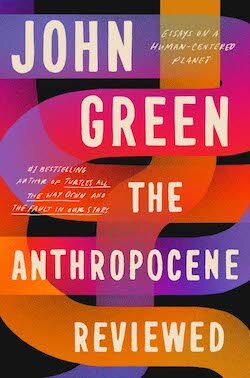 Green would admit that the effort is a bit ludicrous. How do you rate the things that really matter in life? Or the things that resist that kind of reduction, like the Canada geese that gave Green the idea for the book? “The five-star scale doesn’t really exist for humans;” he says, “it exists for data aggregation systems, which is why it did not become standard until the internet era.” (3) The internet does love it some ratings, even if I can’t quite get used to the pressure of maintaining my 5-star AirBnB guest rating. Is my mom keeping track of my visits like this?
Green is known for his popular young adult books like The Fault in Our Stars and Turtles All The Way Down which feature characters with a lot of heart and some adaptive issues. You’ll find both in Green himself who has talked openly about his struggles with Obsessive-Compulsive Disorder. In these essays he talks more directly about the wonder that keeps him engaged with the world.
We all know how loving ends. But I want to fall in love with the world anyway, to let it crack me open. I want to feel what there is to feel while I am here.
—The Anthropocene Reviewed, p. 7
There are no definitive answers in The Anthropocene Reviewed and the ratings seem irrelevant, but they do remind us that we are always evaluating the world around us, or could be if we could focus our distracted selves on the place where we are. The internet, for instance, gets three stars, but more helpful is Green’s observation that “my friend Stan Muller tells me that when you’re living in the middle of history, you never know what it means. I am living in the middle of the internet. I have no idea what it means.” (88)
Sunsets get five stars, natch, but not before Green philosophizes on the power of the sun. “It all makes a kind of sense: I don’t just need the light of that star to survive; I am in many ways a product of its light, which is basically how I feel about God.” (96)
Plagues get one star, but Green pulls a hopeful message out of potential human responses to them. He notes a story from the period of the Black Death when the whole city of Damascus responded with an interfaith procession.
“Even the powerful went barefoot in a statement of equality, and all the people came together in prayer regardless of their religious background…As the poet Robert Frost put it, “The only way out is through.” And the only good way through is together.”
–The Anthropocene Reviewed, p. 213
You might feel tempted to write a few reviews of your own at the end of this book, if only to feel engaged again with the world we so often take for granted. After all, as the book sums it up, “Almost everything turns out to be interesting if you pay the right kind of attention to it.” (276)
I give The Anthropocene Reviewed four-and-a-half stars.


 Heartlands
Leave a comment