
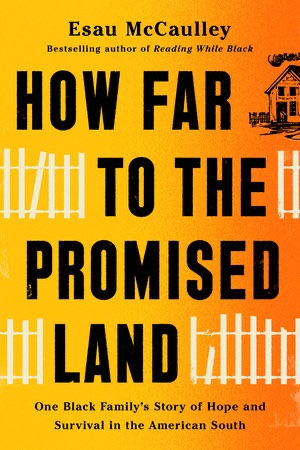
Esau McCaulley recognizes that his story doesn’t easily fit in to the expected grooves. He’s a dedicated Christian and associate professor of New Testament at Wheaton College who made some of his evangelical colleagues nervous with his breakout book, Reading While Black, which looked at the Bible through an African-American lens. He’s a Southerner who knows the troubled racial history of the South firsthand and is not afraid to talk about it. And he’s the product of the Black church who recognizes that he has a different calling than that of a traditional Black preacher. His call is “to try to put into words and on paper the varied experiences of God in the souls of Black folks.” (150)
So in his most recent book, How Far to the Promised Land: One Black Family’s Story of Hope and Survival in the American South (Convergent, 2023), he doesn’t try to tell every Black Christian’s story, but does offer his own in rich detail. You come out of this memoir feeling McCaulley’s hard-won wisdom, openness, and faith. His difficult, often-absent, father, his resilient mother, his racially-intolerant in-laws, and his big, loving Alabama family all find their place in McCaulley’s heart.

Early on McCaulley acknowledges that every Black story in the United States involves the struggle with evil, but, he says:
“The lack of a speedy deliverance frustrated and perplexed me, but I never doubted my experiences of God. It was how I survived. God and I have been through hard times together; we have a relationship born of that intimacy. If there is a testimony that deserves our attention, it is the large number of folks who believe there is no other way to tell the Black story in the United States without affirming that God carried us through.” (16)
How Far to the Promised Land is a thin book, (210 pages), that would make for great discussion in a small group study. It’s also an affecting read that is valuable just because it doesn’t go where you expect it might.

 Heartlands
Leave a comment