
Brian Zahnd’s mind is a funhouse of mirrors. When you read his books you feel as though you’ve entered a maze of slant images, each reflecting back a piece of the theme he’s trying to share with you. So it was bracing to read in the preface to his new book that he was looking for a single, simple touchstone to ground a faith.
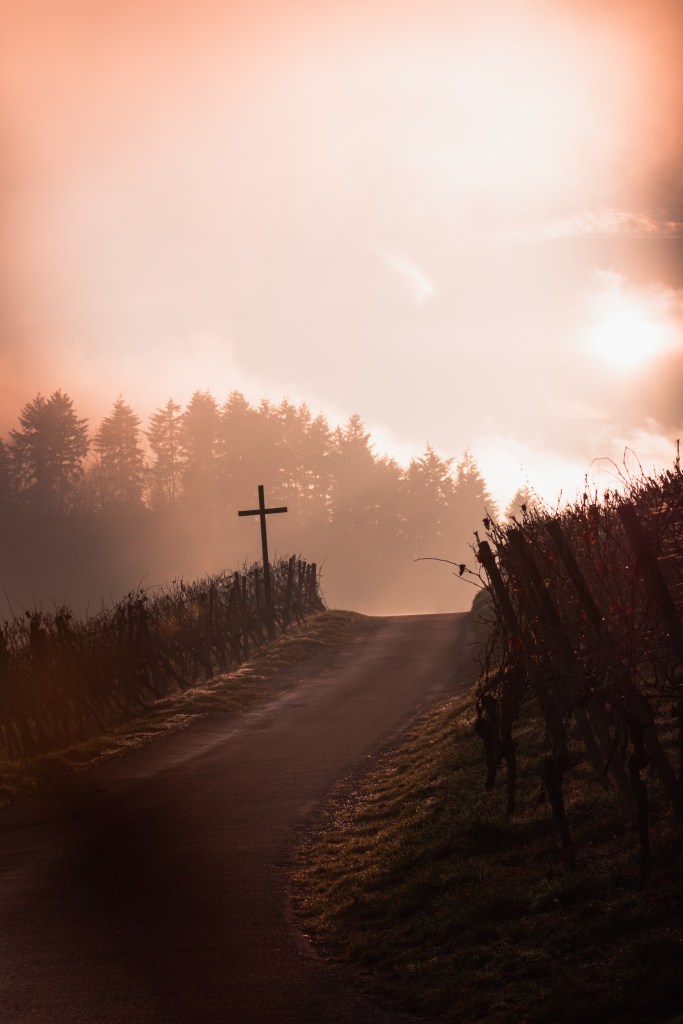
We need to locate an interpretive center—a focal point from which we can interpret the rest of the Bible. We need to locate the heart of the Bible. As a Christian, I have a ready and, what seems to me, obvious location for the heart the Bible: the cross. All that can truthfully be said about God is somehow present at the cross. (2)
—Brian Zahnd
Aha! So there’s the nub. And then we read on:
The meaning of the cross is not singular, but kaleidoscopic…There are an infinite number of ways of viewing the cross of Christ as the beautiful form that saves the world. (3)
—Brian Zahnd
And off we go on another of Zahnd’s wild rides.
The thing about a funhouse, though, is that it’s…fun. The Wood Between the Worlds: A Poetic Theology of the Cross [IVP, 2024], may be an intimidating title, but you’re as likely to meet Tolkein and Coltrane as you are St. Augustine and James Cone in these pages. Zahnd, a longtime Missouri pastor of Word of Life Church, drinks deeply from the culture around him as well as from the resources of the Christian tradition. And he finds God everywhere.
But he does keep coming back to the cross, each time with a slightly different take on its confounding message. Sometimes we’re dealing with the deficiencies of an American evangelical fascination with a particular kind of bloody atonement theory. At other points we’re reflecting on the lynching tree as an illuminating parallel to the cross or the meaning of the harrowing of hell as a picture of Christ overcoming death on behalf of all humanity.

In every place we’re seeing a pastor-theologian overtaken with the possibilities of beauty as a way of engaging truth in the postmodern world.
At the cross we find the ugliness of human sin, but we also find the beauty of divine love—the beauty that saves the world…If crucifixion can be made beautiful, all things can be made beautiful…If our churches can learn to enact the beauty of Christ crucified and thereby become pavilions of peace instead of culture-war barracks, we can begin to recover our swiftly diminishing relevance. (73-74)
—Brian Zahnd
Not that relevance is the point, although Zahnd does have a special urgency to make the Christian faith possible for the contemporary world. His most recent book, When Everything’s On Fire, (reviewed on Heartlands), was his attempt to explain his own ‘renovation’ of his faith and to build a credible platform for belief so that his grandchildren could claim it as well.
As the title of this book suggests, Zahnd leans heavily on a type of poetry to speak into this new age.
Poetry is the best vehicle we have for attempting to articulate the ineffable…But we do not live in a poetic age. We live in a technical age, a digital age of 1s and 0s. We live in an age that Walter Brueggemann calls a “prose-flattened world. (194)
—Brian Zahnd
And in its own strange way, the cross is a kind of poetry—a symbol that speaks beyond reason to the mystery of God’s ways in the world. By attending to this symbol in the same multivalent way one would look at a poem, Zahnd finds rich layers of meaning to speak to our souls.
The Wood Between the Worlds is arriving just in time for Lent 2024 and it makes a useful companion for individuals and groups walking through that season. It can’t fail to provoke with its rollicking detours into so many veins of culture and history, but it always returns to the center and does not let us look away from the crucified Christ whose death unleashes every incredible journey.



 Heartlands
Leave a reply to Pamela Dilmore Cancel reply