
My feature review of Fleming Rutledge’s new book on preaching is up on the Englewood Review of Books site. It is reprinted here with permission.
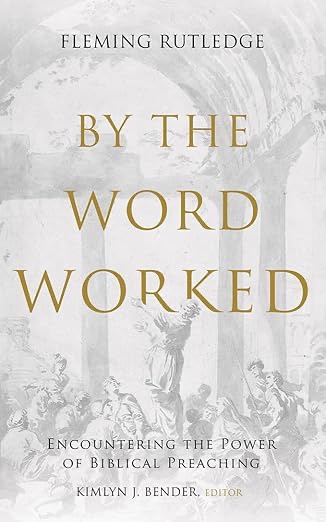
By the Word Worked
Fleming Rutledge
Baylor University Press, 2024
Reviewed by Alex Joyner
For all the space it takes up in our worship services, the sermon as an object of critical study has suffered from criminal neglect. It’s not that preachers these days don’t have the ability to be creative. No, most of us have our trusty bag of tricks and we’re inveterate magpies, plucking shiny objects and sparkling techniques from other practitioners and cultural media to put to our own use.
It’s just that we don’t often stop to think about what it is that we’re doing up there during the twelve to forty minute stretch most congregations allow for the exercise. Is it a biblical information dump? A motivational speech for other church programming? A harangue for better behavior? Thinly-veiled political commentary? An introspective exploration of the preacher’s soul? Or could it be…you know…a word from God?
Fleming Rutledge has heard and delivered a lot of sermons in her long career as a preacher-teacher-theologian and she is not impressed with the current state of the homiletical world. Fortunately she still loves preaching and continues to write books that have fueled a revival of interest in the craft within her own Episcopal tradition and far beyond into evangelical and other mainline churches. Which is how she came to be delivering the 2019 Parchman Lectures at Truett Theological Seminary at Baylor University. The lectures have now been turned into By the Word Worked, which she calls “an attempt to build something constructive in the midst of what I see as a preaching desert.” (19)
Rutledge diagnoses the problem with preaching right up front. It is that both preachers and hearers have given up the expectation that they are going to hear God speaking in the words of the sermon. “I get the impression that most congregations don’t seem to have a sense of the biblical doctrine of the Word of God. They don’t expect anything life-changing from the sermon. There is no excitement about the sermon, no anticipation.” (16) In contrast, her conviction is that “God is the animating agency inhabiting the written text as the preacher is led by the Holy Spirit, speaking words that effect what God intends.” (18, emphasis in original)
If that sounds ponderous, read on. Through the course of this slim book, Rutledge pokes at sacred cows and hobby horses of left and right, manages a convincing appreciation of postmodernism, and illuminates the way out of the box most preachers find themselves in as they try to balance being authentic without being oppressive (the coin of the realm in modern communication) and faithful to a God who takes a wrecking ball to every certainty.
Rutledge starts with observations on some unfortunate trends that have weakened preaching along with corresponding counter-affirmations. The weaknesses she sees will not be unfamiliar to those who have spent some time with Karl Barth’s work. Like Barth, Fleming sees that “human potential and human possibility” have moved to center stage in our religious thought and God has shrunk to the elusive object of human searching, if God is present at all. Similarly, Fleming notes a turn in preaching toward a “Jesus kerygma,” which focuses on the ministry and teaching of the human Jesus, rather than a “Christ kerygma” that reflects the high Christology of the whole New Testament record.
The result of all this is an emphasis on what we are doing or should do, rather than on what God is doing in the world. As Rutledge puts it, “I have heard probably fifty or sixty sermons on the transfiguration in my lifetime. Ninety-five percent of them have missed the point. Most of them have been about Peter…The transfiguration is a theophany. It’s about God.” (28-29)
After moving through a section on how postmodernism, for all its excesses, has broken the tyranny of historical-critical readings and opened the door for the imagination in interpretation, Rutledge has cleared the way for an explication of the classic theme of her most recent work—the reclamation of the apocalyptic worldview in Christian thought. The condensed nature of this book makes it a great introduction for those who might be intimidated by the thick tome that is her magisterial 2015 book, The Crucifixion.
In the final chapter of By the Word Worked, Rutledge identifies how the spiritual landscape and horizon of the postexilic prophetic books and the New Testament provide a sense of drama that could remedy one of her other observations—sermons these days are “timid” and “lack a sense of urgency” (20-21). The New Testament is permeated by an awareness of a conflict among powers. Too much preaching has flattened this conflict into a narrative of humans, (and too often individual humans), who are living out history against the backdrop of a fairly passive God. Rutledge reintroduces the Pauline powers of Sin & Death that rage against God and says, “In the back of every preacher’s mind there should be that truth: we’re all going to die…The fact of death puts a different face on our claims to virtuous achievement.” (61)
Preaching, therefore, cannot be a matter of moving the individual to a heroic choice for faith or of spurring us to virtuous action on behalf of the cause du jour. Preaching proclaims that “the appearance of Jesus Christ the living Word of God in this territory occupied by an Adversary is an invasion from another dimension of power.” (83) And that invasion reveals what God is up to in the world.
Every preacher and hearer will be disturbed by Rutledge’s astringent analysis. She’s not out to win friends. She’s just doing what she has done for so long—listening for the Word and letting it work her over. And looking for the transcendence she longs for from good preaching. Hence, her final words here: “I could feel the longing for a translation into the realm of God, if only for a moment…Preachers, take us up!” (84)



 Heartlands
Leave a reply to #9 – By the Word Worked by Fleming Rutledge – 2025 Best Reads – Heartlands Cancel reply