
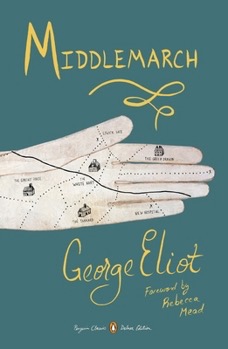
At least once in their life, everyone must read Middlemarch. Or so it seems from the frequent rapturous mentions George Eliot’s 1872 novel receives in literature and book circles. It seems churlish to put something so beloved and so deserving at #7 on the list, but Ms. Eliot is hampered by the Best Reads recency-bias.
It’s more than a notion to take on a 900-page tome, even if it is a classic. I recommend moving slowly through the manageable chapters. You’ll soon fall in love with the idealistic Dorothea Brooke, her more practical sister Celia, and the many other characters who occupy this novel of provincial life in 1830s England. Despite the fact that the most noxious character, Edward Casaubon, is a clergyman and that too many scenes take place with two people sitting in a room, there is depth and insight in every section.
Among the many quotable lines is this one near the end of the book:
Her finely-touched spirit has still its fine issues, though they were not widely visible. Her full nature, like that river of which Cyrus broke the strength, spent itself in channels which had no great name on the earth. But the effect of her being on those around her was incalculably diffusive: for the growing good of the world is partly dependent on unhistoric acts; and that things are not so ill with you and me as they might have been, is half owing to the number who lived faithfully a hidden life, and rest in unvisited tombs. (889)
It may have taken 150 years, but you’ve made the list George Eliot!
Previously in this series:
#8 – Small Things Like These by Claire Keegan





Leave a Reply